Dressmaker Game Cutting
Grain vs bias explained — why fabric placement shows on the finished dress.
Facts last checked: September 14, 2026
Pre-release coverage: everything below comes from official store pages, press previews and demo hands-on. We plan to review the relevant information after the game launches on September 21, 2026.
Cutting Overview
Cutting is the game's signature system. The Steam page makes the promise explicit: whether your pattern is aligned to the grain or cut on bias, how you choose to arrange and cut out your fabric is what appears on the final dress. Your layout carries through to the finished garment, including the grain alignment and print direction.
Each pattern piece can be cut from its own fabric, so the cutting table is also where multi-fabric designs happen: pick the cloth per panel, then lay everything out.
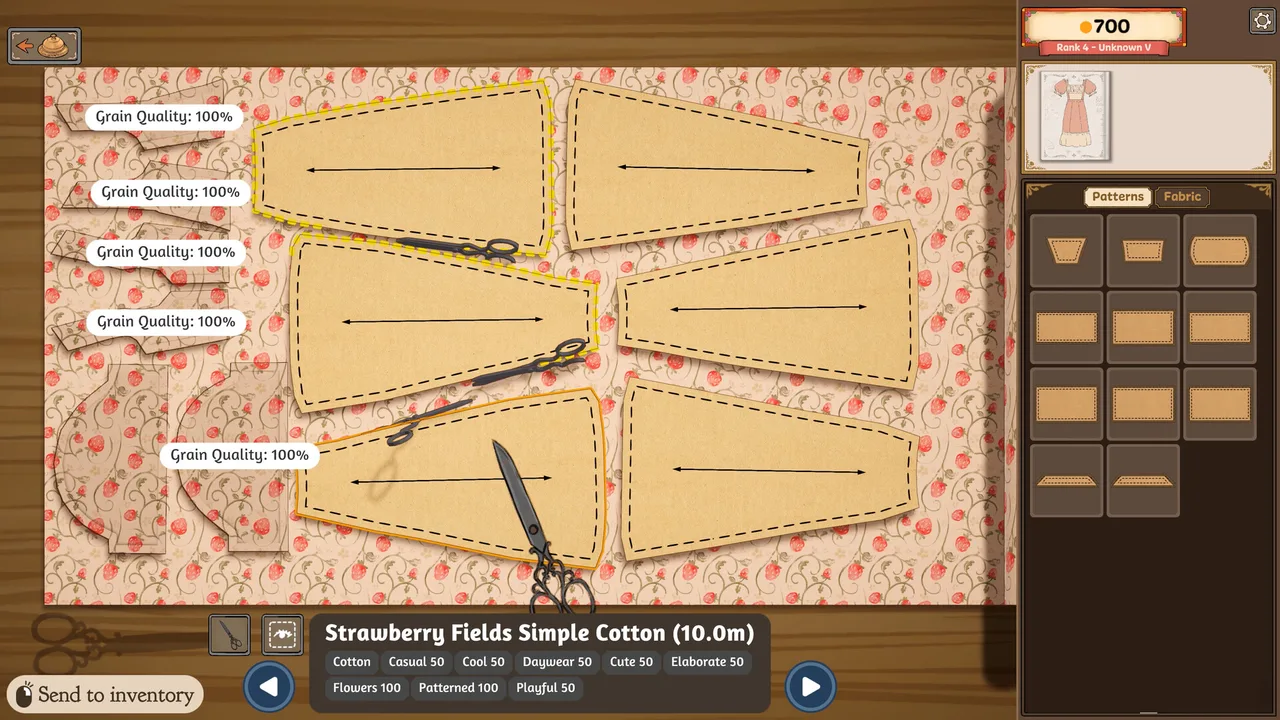
The still labels pieces Grain Quality 100% and draws grainline arrows. Send to inventory is on that screen. The percentage formula is not printed. The bolt on that frame is Strawberry Fields Simple Cotton at 10.0 m remaining — that is the remaining length shown in this screenshot, not a confirmed starting quantity.
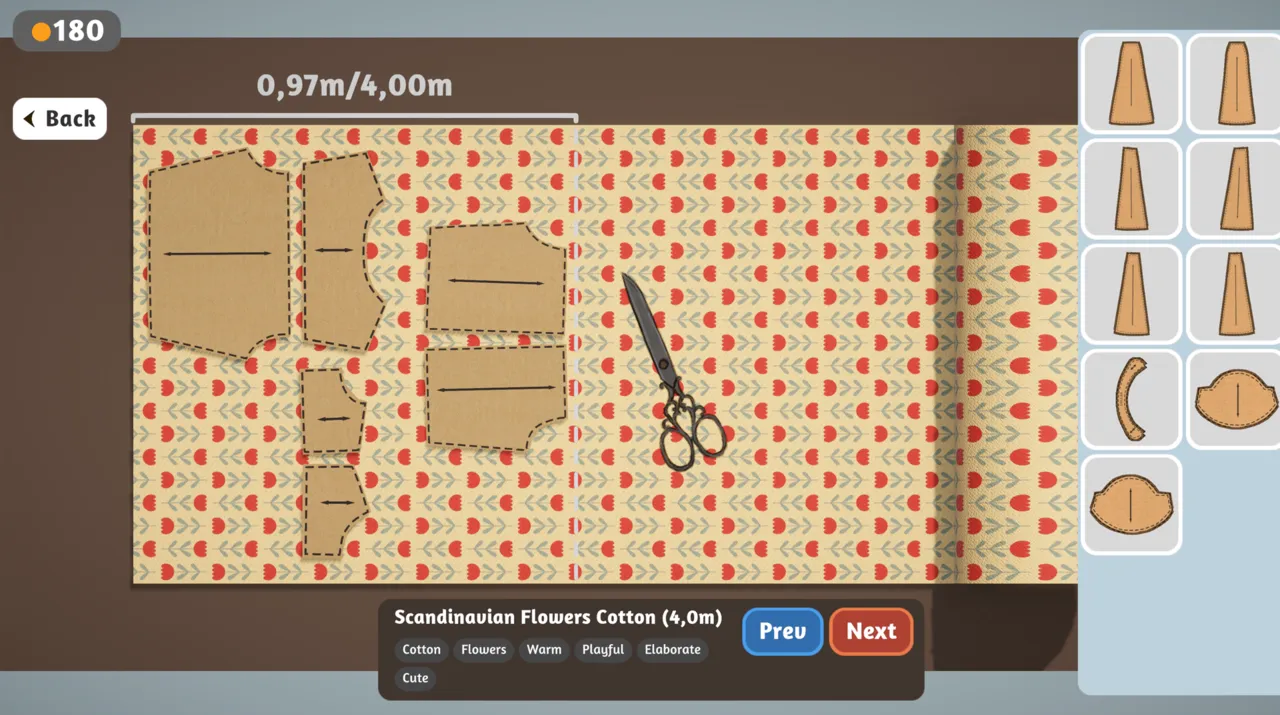
Prototype v0.5.5 cutting table from the official itch gallery (saved 15 September 2026). The bolt is labelled Scandinavian Flowers Cotton (4,0m), with 0,97m/4,00m used, grainline arrows on the paper pieces, scissors, and Prev/Next. Tags on that still read Cotton, Flowers, Warm, Playful, Elaborate, Cute. Lengths and tags are this frame, not a catalogue. Launch layout may change; the Steam still above is the current full-game reference.
Grain vs Bias, Explained
The game borrows real dressmaking rules (prototype-era press deep-dive; in-game numbers re-verified at launch):
| Placement | Real-world meaning | Effect on the dress |
|---|---|---|
| On the grain | Pattern aligned with the fabric's weave threads | Stable and structured — holds its shape |
| On the bias | Cut at 45° to the weave | Drapes and stretches — flowing silhouettes |
Print direction matters too: a patterned fabric cut askew shows askew on the dress (TechTimes deep-dive, August 2026). And economical pattern layout — the pleasure of fitting pieces close together, borrowed from real dressmakers — is cited by the developers as a design origin (Creative Bloq interview, August 2026).
Confirmed So Far
| Element | Details | Source |
|---|---|---|
| Grain / bias choice | Placement shows on the final dress | Steam store description |
| Per-panel fabric | Each pattern piece can use its own fabric | Steam store description |
| Cutting table | Arrange-and-cut workflow on a dedicated station | Steam description; prototype devlogs |
| Layout economy | Tight layouts as a deliberate design pleasure | Creative Bloq developer interview, Aug 2026 |
Open Questions for Launch
- Whether layout efficiency is scored, or purely a fabric-economy choice.
- How bias cutting changes specific dress patterns in play.
- Prototype players asked to rotate or flip prints so a pattern faces the right way; that is a request, not a confirmed launch control. Ruffle skirts and leftover fabric on long panels are also common v0.5.5 complaints, not launch-verified technique.
Start with the beginner guide if you are new to the game.
Frequently Asked Questions
What does cutting on the bias do in Dressmaker?
Bias-cut pieces sit at 45° to the fabric weave: in real dressmaking that makes cloth drape and stretch, and press coverage of the game confirms the same contrast — grain for structure, bias for flow. Exact in-game numbers are unverified until launch.
Does fabric placement really change the finished dress?
Yes — the Steam page states that how you arrange and cut the fabric is what appears on the final dress, including grain or bias alignment and print direction.